
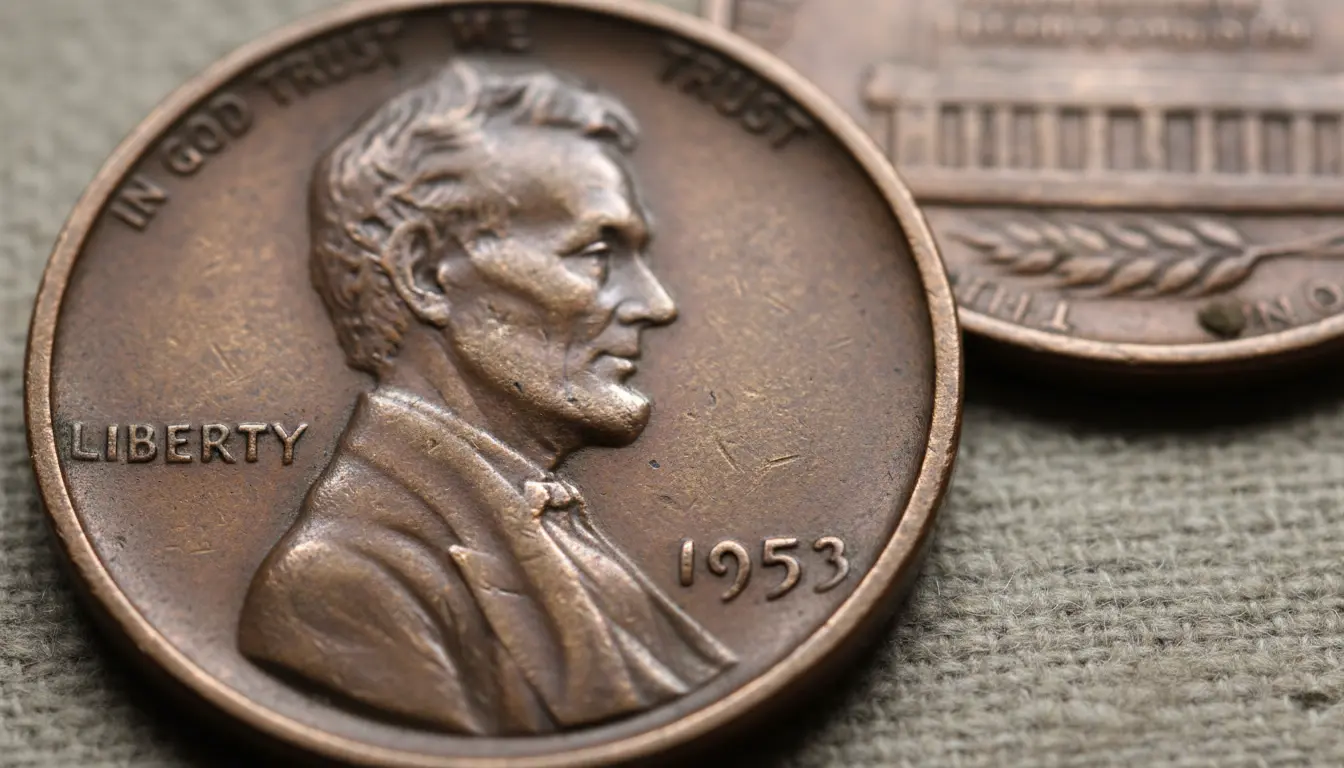
The 1953 Wheat Penny is a common Lincoln cent that can still hide valuable examples. This guide shows how to identify mint marks, estimate 1953 Wheat Penny value, spot error coins, and decide when to grade or sell.
How to Identify a 1953 Wheat Penny
Look closely at the obverse (front) for the date 1953 and the mint mark. The mint mark, if present, is under the date on the right side of Lincoln’s bust. No mint mark means Philadelphia.
Mint marks and locations
- 1953 (no mint mark) — Philadelphia
- 1953-D — Denver
- 1953-S — San Francisco

The reverse has the wheat ears design (two wheat stalks) and the words UNITED STATES OF AMERICA and ONE CENT. This wheat reverse identifies these as Wheat Pennies rather than later memorial or shield designs.
Common visual checks
- Check for wear on Lincoln’s cheek and jaw — heavy wear drops value sharply.
- Inspect the rim for full details — strong rims suggest higher grade.
- Use a 10x loupe to search for doubling, repunched mint marks, or die cracks.
1953 Wheat Penny Value Guide
Values depend heavily on condition (grade), mint mark, and whether the coin is a special variety or error. Typical market ranges are below and reflect average retail prices as of recent market trends.
- Circulated (Good to Fine): 2¢ to 25¢ — most 1953 cents fall here.
- Extremely Fine to About Uncirculated: 25¢ to $2 — better eye appeal and sharper detail.
- Uncirculated (MS60–MS63): $1 to $8 — common uncirculated survivors.
- Higher Mint State (MS64–MS65): $8 to $60 — popularity and strike quality affect these prices.
- Proof and Certified High Grades (PR/Special & MS66+): $50 to several hundred dollars — proof sets and top-graded specimens are scarce.
Note: Exact values shift with market demand and grading. Always check recent auction sales and price guides before selling or buying.
Where big money can appear
- Certified high-grade coins (MS66 or better) from any mint.
- Error coins like major off-center strikes, large doubled dies, or planchet flaws.
- Proof coins in original packaging or high graded proofs.
Rare 1953 Wheat Penny Varieties to Watch For

Most 1953 cents are common, but a few varieties and errors attract collectors and premium prices.
- Doubled die obverse or reverse — visible doubling of letters or date.
- Repunched mint marks (RPMs) — a second impression at the mint can make a coin desirable.
- Off-center strikes — value grows with the degree of off-centering and remaining design.
- Planchet errors — clipped planchets, lamination errors, and wrong metal planchets.
- High-grade survivors and proof examples — the key rarity is condition.
How to Grade and Sell a 1953 Wheat Penny
Start by grading to the best of your ability: determine if the coin is circulated or uncirculated, then look for strike quality, luster, and hairline marks. If you think a coin may be valuable, consider professional grading.
Practical grading and selling steps
- Clean coins should be avoided; cleaning reduces value. Handle by edges and use cotton gloves if possible.
- Use a 10x loupe and a neutral light to inspect details and detect doubling or errors.
- Compare with reliable photos from grading services and price guides.
- For suspected high-value pieces, submit the coin to a major grading service (PCGS or NGC).
- When selling, check recent sold listings on auction sites, consult local dealers, and get multiple offers.
The Lincoln Wheat reverse was used on pennies from 1909 through 1958. Collectors still prize well-preserved wheat cents for their historical value.
Quick Checklist Before You Sell
- Identify mint mark and confirm the date clearly reads 1953.
- Document any doubling, repunched marks, or visible errors with clear photos.
- Compare with recent auction results for similar grade and variety.
- Consider professional grading for coins likely to exceed $100 in value.
Real-World Example

A hobbyist found a roll of mixed pennies and noticed a 1953-D with sharp detail and strong luster. After having the coin graded, it received an MS64 grade and the owner sold it to a dealer for about $120. The premium came from strike quality and surface preservation.
Final Tips on 1953 Wheat Penny Value
Most 1953 Wheat Pennies are inexpensive but worth checking for errors and high grades. Use careful inspection, compare recent sales, and grade or consign coins that show exceptional detail or unusual errors. That approach helps you identify the rare 1953 cents that may be worth significantly more than face value.