
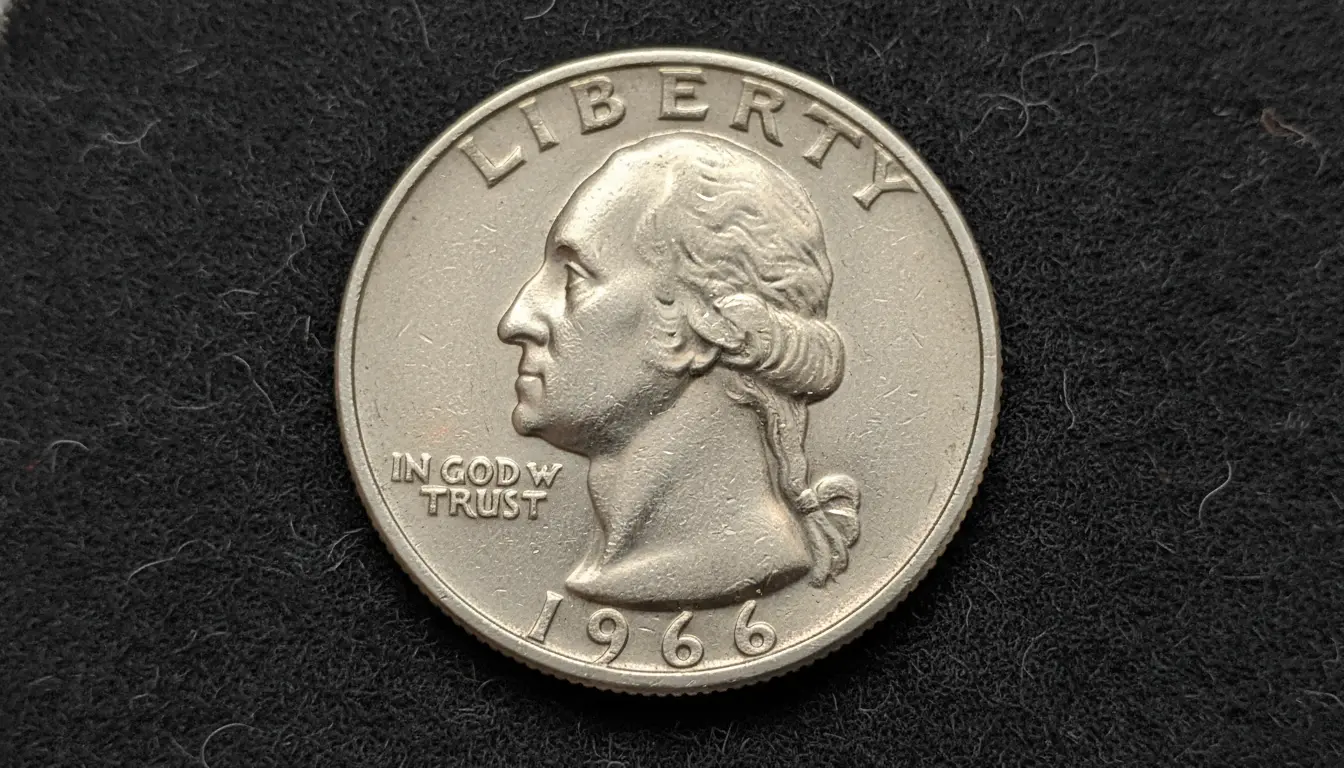
1966 Washington Quarter Overview
The 1966 Washington Quarter is a common-date U.S. coin from the post‑silver era. It belongs to the long-running Washington quarter series that began in 1932.
This guide explains how to identify authentic 1966 quarters, what affects their value, and practical steps for collectors and sellers.
Composition and design of the 1966 Washington Quarter

The 1966 quarter is a copper‑nickel clad coin. The outer layers are an alloy of 75% copper and 25% nickel bonded to a pure copper core.
Obverse and reverse designs remain the familiar John Flanagan portrait of George Washington and the heraldic eagle on the reverse. These design elements help with quick visual identification.
Mint marks and production notes for the 1966 Washington Quarter
Between 1965 and 1967 the U.S. Mint temporarily stopped using mint marks on circulating coins. The 1966 Washington Quarter therefore shows no mint mark on the obverse, even if struck at Denver or Philadelphia.

The absence of a mint mark is normal and does not indicate a special variety or error for 1966 quarters.
How to identify a genuine 1966 Washington Quarter
Follow a structured check to be confident your coin is a genuine 1966 Washington Quarter. Use these steps in order.
- Look at the date: The coin should clearly read 1966 on the obverse under Washington’s chin.
- Check composition: The coin should show a copper edge when viewed on its rim; the outer faces are silver‑colored, not solid silver.
- Confirm no mint mark: The area above the date or near the truncation of Washington should show no mint letter.
- Examine the edge: Quarters have a reeded edge; missing or altered reeds suggest damage or tampering.
- Feel the weight: A genuine clad quarter weighs about 5.67 grams. If you have a precise scale check it.
Also avoid cleaning coins with abrasives. Cleaning can damage surfaces and reduce market value significantly.
Common errors and varieties to watch for

1966 quarters are not known for major rare die varieties, but collectors sometimes find examples with doubling, weak strikes, or die chips. These are usually minor and do not create dramatic value jumps unless verified by experts.
If you find an unusual feature, photograph it clearly and consider submitting the coin to a grading service for authentication.
From 1965–1967 the U.S. Mint removed mint marks to deter coin hoarding during coinage transitions. That means 1966 quarters were struck at multiple facilities but carry no mint mark.
Value and grading for the 1966 Washington Quarter
Most 1966 Washington Quarters are common and remain worth close to face value in circulated grades. Key factors that affect value are strike quality, surface condition, and whether the coin is certified by a major grading service.
Typical value ranges
- Circulated condition: Typically worth between face value (25 cents) and a few dollars, depending on wear and eye appeal.
- Uncirculated condition (MS60–MS63): Often valued at a few dollars to $20–$40 in dealer or auction listings.
- High uncirculated grades (MS64+ and above): These coins can command higher premiums. Prices vary widely depending on grade and market demand.
Exact market prices change over time. Use recent auction results or price guides when estimating the current value.
When to get a 1966 quarter graded
Consider grading if the coin appears to be high uncirculated (strong luster, full detail) or shows an unusual error. Grading adds a certification that can significantly improve buyer confidence when selling.
For low‑value circulated pieces, grading costs usually outweigh benefits. For higher grade candidates, submit only after consulting current market prices and a reputable dealer.
Buying, selling, and storage tips
Follow practical steps to protect value and avoid scams when trading 1966 quarters.
- Buy from reputable dealers or established auction sites with return policies.
- Keep coins in inert holders (Mylar flips, archival pages, or certified slabs) to avoid chemical damage.
- Handle by the edges and avoid fingerprints on faces.
- Get high‑value coins certified by an established grading service before selling for best exposure.
Simple authenticity checklist for sellers
- Confirm date and absence of mint mark (normal for 1966).
- Weigh the coin with a precise scale if possible.
- Inspect for plating or obvious post‑mint alterations.
- Provide clear photos showing obverse, reverse, and edge.
Real‑World Example: A Small Case Study
A local collector bought a mixed roll of quarters and found an uncirculated 1966 Washington Quarter with strong luster. The coin had full hair detail and no visible wear.
After submitting the coin to a grading service, it received an MS64 grade. The collector later sold the slabbed coin through an online auction for a modest premium over typical market listings, illustrating how grading can add confidence and a price boost.
Final practical checklist for the 1966 Washington Quarter
- Confirm the date 1966 and no mint mark; this is normal for the period.
- Verify clad composition and weight (about 5.67 g).
- Avoid cleaning. Preserve original surfaces for possible grading.
- Use grading selectively for high‑grade candidates or suspected errors.
With a steady market and many examples available, the 1966 Washington Quarter is a great coin for beginners to inspect and learn basic coin authentication. Use the steps above to assess condition and value practically and avoid common pitfalls.