
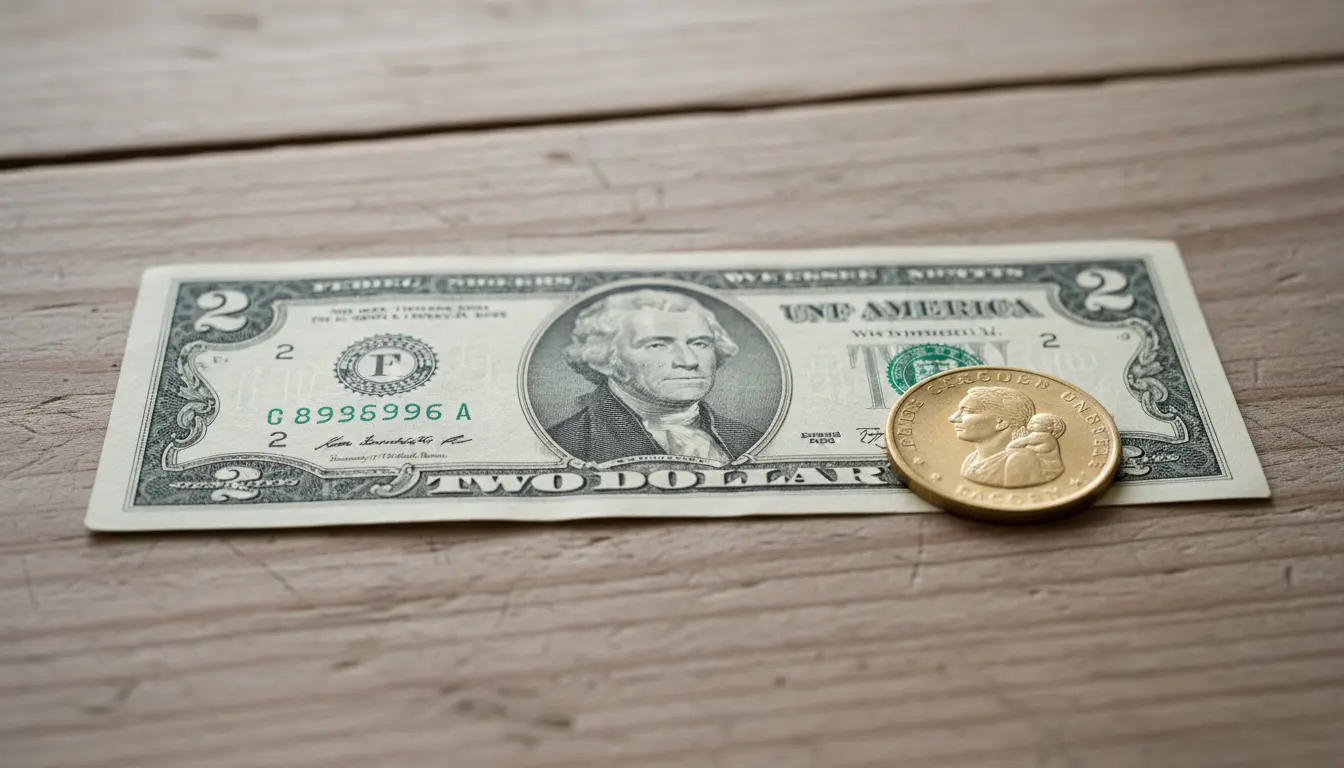
Overview: 2 Bill vs Sacagawea Dollar
This article compares the $2 bill and the Sacagawea dollar for everyday users and collectors. You will learn design differences, circulation patterns, common values, and practical steps to spot worth.
What Are They?
The $2 bill is a United States paper banknote featuring Thomas Jefferson on the front. The Sacagawea dollar is a one-dollar coin introduced in 2000 featuring Sacagawea and her child on the obverse.

Both are legal tender, but they serve different roles in circulation and collecting markets.
Design and History: 2 Bill vs Sacagawea Dollar
The $2 bill has a long history, first printed in 1862 with many design changes. The modern series for daily use returned in 1976 with a new reverse showing the signing of the Declaration of Independence.
The Sacagawea dollar was launched in 2000 to provide a more attractive and durable dollar coin. Its golden color comes from a manganese-brass clad composition.
Key design points
- $2 bill: Paper note, green Treasury seal, larger physical size than coins.
- Sacagawea dollar: Coin, golden tone, reedless edge on most series, inscriptions on the edge on Native American series (2009–present).
- Both include security and mint marks useful for identification.
Size, Composition, and Durability

Coins last much longer in circulation than paper notes. A modern Sacagawea dollar can remain usable for decades; a paper $2 bill may show wear in a few years depending on handling.
Composition differences matter for collectors: the Sacagawea dollar’s alloy gives it a distinct look and weight, which helps in authentication.
Circulation and Everyday Use
Neither the $2 bill nor the Sacagawea dollar is widespread in everyday transactions, but for different reasons. The $2 bill is often hoarded as a curiosity while the Sacagawea dollar competed with the more familiar quarter and dollar coins.

Businesses may accept either, but cashiers unfamiliar with the $2 bill sometimes mistake it for a counterfeit or overlook the Sacagawea dollar as uncommon change.
Collecting Value: 2 Bill vs Sacagawea Dollar
Most modern $2 bills and Sacagawea dollars are worth face value when circulated. Collector value arises from condition, year, mint mark, and errors.
Common collecting rules:
- Uncirculated condition (MS/UNC) raises value significantly.
- Key dates and low-mintage runs are more valuable.
- Error notes and coins (misprints, minting errors) can attract premiums.
Typical value ranges
- Circulated $2 bills: usually worth face value and sometimes $3–$10 if older or attractive.
- Uncirculated or rare $2 bills: can range from $20 to several hundred dollars depending on date and rarity.
- Circulated Sacagawea dollars: usually face value of $1; uncirculated pieces may sell for $2–$10.
- Rare Sacagawea issues or mint errors: can reach $50–$500 or more for notable examples.
How to Spot Rare Examples
Examine mint marks, dates, edge lettering, and condition. For Sacagawea dollars, look for special designs, proof strikes, or edge errors. For $2 bills, look for older series dates, star notes, and misalignments.
Use a magnifier, compare to reference photos, and check reputable price guides or auction results before assuming high value.
Where to Buy, Sell, and Get Graded
Good sources include coin dealers, certified auctions, and online marketplaces with buyer protections. For high-value items, consider third-party grading services like PCGS or NGC for coins, and PMG or PCGS Currency for notes.
Grading adds credibility and often helps achieve higher sale prices, but fees and shipping risks should be considered.
Practical Tips for Everyday Users and Collectors
- Keep unusual finds separate and in protective sleeves or coin flips.
- Check bank rolls and change when possible — you can sometimes find Sacagawea dollars in mixed rolls.
- Ask for $2 bills at the bank if you want to use them; tellers can often supply them on request.
- Document provenance when buying higher-value items to support authenticity for buyers later.
The Sacagawea dollar was intentionally given a golden color to make it distinct from other U.S. coins and to encourage public acceptance. Despite that, many people still prefer paper notes for convenience.
Real-World Example: Small Shop Case Study
A small coffee shop in Denver began giving Sacagawea dollars as change to regulars to clear a bulk box they received from a bank. Customers liked the novelty and many kept the coins as mementos, reducing the shop’s coin handling time.
One patron later sold a near-mint Sacagawea proof from the same batch to a collector online for $45, showing how condition and origin can add value beyond face amount.
Summary: Which Is Better for You?
If you want durable day-to-day currency, the Sacagawea dollar is more resilient. If you want a niche collectible that still occasionally circulates, the $2 bill has historical charm and collecting interest.
For collectors, focus on condition, rare dates, and authenticated grading. For everyday use, carry whichever you and local businesses accept comfortably.
Use the guidance here to identify, protect, and potentially profit from finds. When in doubt, consult a reputable dealer or grading service before selling a suspected valuable piece.