
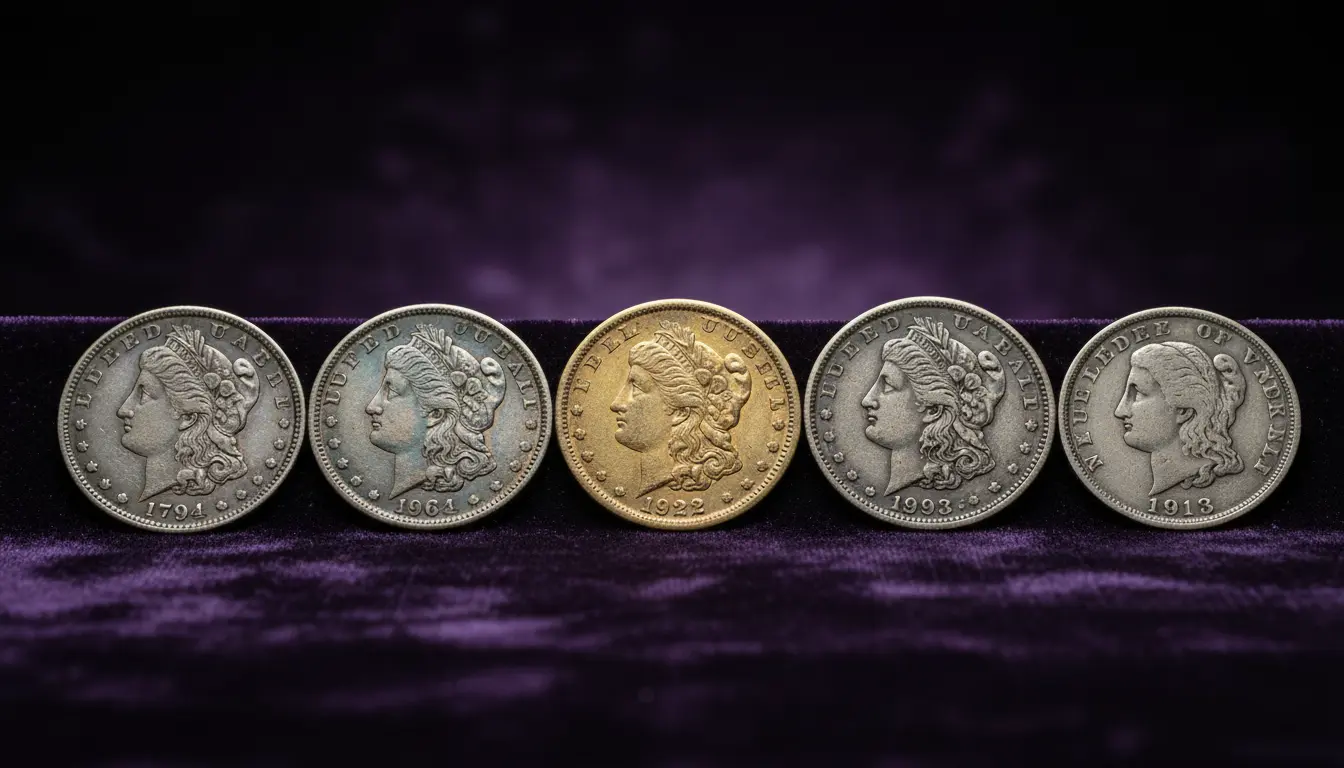
This guide explains five ultra-rare US coins every collector should know. It focuses on how to identify them, why they are rare, and practical steps for authentication and storage.
Top 5 Ultra-Rare US Coins Overview
These five coins span early federal issues to 20th-century rarities. Each has distinct historical context and market behavior, which affects value and desirability.
1. 1794 Flowing Hair Silver Dollar

Issued in the first year of the silver dollar, the 1794 Flowing Hair is prized for its historical importance. Surviving specimens are extremely scarce and often appear in exceptional condition.
Key identifiers:
- Flowing Hair obverse portrait and small eagle reverse.
- Edge lettered or plain depending on variety.
- Distinctive die markers visible under magnification.
Market note: authenticated examples have achieved very strong auction results. Condition and provenance are decisive for pricing.
2. 1804 Draped Bust Silver Dollar (Class I)

The 1804 silver dollar is famous as the “King of American Coins.” Despite the date, most surviving coins were struck in later decades as diplomatic presentation pieces.
Key identifiers:
- Obverse: Draped Bust portrait; reverse: heraldic eagle on many Class I pieces.
- Class I pieces were struck with intentional minting for presentation sets.
- Die and edge features distinguish authentic examples from later restrikes and counterfeits.
Collector tip: work with an experienced numismatist when evaluating an 1804 silver dollar to confirm class and provenance.
3. 1822 Half Eagle ($5 Gold)

The 1822 Half Eagle is a rare early gold issue with only a few verified examples. Its rarity stems from limited production and subsequent survival rates.
Key identifiers:
- Small number of surviving coins and known die characteristics.
- Often shows planchet and strike anomalies typical of early minting.
Practical note: gold content and hallmark features can be verified by non-invasive assays and specialist grading services.
4. 1913 Liberty Head Nickel
Only five confirmed 1913 Liberty Head nickels exist, making them among the most famous U.S. rarities. Each piece has a well-documented chain of ownership.
Key identifiers:
- Liberty head design dated 1913, not the regular Buffalo nickel.
- Provenance records and minting anomalies are essential for validation.
Market note: authenticated examples trade among major collectors and museums; auction results reflect extreme collector demand.
5. 1933 Saint-Gaudens Double Eagle
This gold double eagle is infamous because most 1933 coins were melted after gold recall. A very small number survive under complex legal circumstances.
Key identifiers:
- Saint-Gaudens design and 1933 date are obvious, but legal status and release documentation are critical.
- Authentication requires grading service confirmation and provenance paperwork.
Legal tip: ownership and sale of 1933 double eagles have been subject to legal review; always confirm title and export rules before buying.
How to Authenticate Ultra-Rare US Coins
Authentication combines visual inspection, documentation review, and expert grading. Use multiple verification methods for high-value pieces.
- Professional grading service (PCGS, NGC) opinion.
- Compare die markers and weight to authoritative references.
- Provenance and auction records strengthen authenticity claims.
- Non-destructive testing for metal composition when needed.
Storage and Preservation Tips for Ultra-Rare US Coins
Proper storage preserves value and prevents damage. Even small environmental changes can affect patina and metal surfaces.
- Use inert holders or archival-grade flip sleeves for short-term storage.
- For long-term, keep coins in climate-controlled safes with stable humidity under 50%.
- Avoid cleaning rare coins; cleaning typically reduces value.
- Document storage conditions and maintain insurance with an appraised value.
Real-World Example: A Small Case Study
A private collector acquired a well-documented 1913 Liberty Head nickel through an established auction house. The buyer required third-party grading and confirmed provenance before bidding.
After acquisition the coin was kept in a bank safe deposit box and insured for the purchase price. Five years later market interest had increased and the piece was resold through the same auction house at a higher price, reflecting authenticated rarity and strong provenance.
Practical Buying Checklist for Ultra-Rare US Coins
Before you buy, run through this concise checklist to reduce risk and confirm value.
- Request certified grading and high-resolution photos showing die details.
- Ask for full provenance and any export or legal documentation.
- Check recent auction records for realized prices of comparable specimens.
- Confirm insurance and secure transportation for shipment.
- Use escrow services for high-value transactions when possible.
Conclusion
These five ultra-rare US coins combine historical interest and strong collector demand. Authentication, proper storage, and clear provenance are essential for preserving both their value and legacy.
For serious collectors, working with reputable dealers, grading services, and legal advisors will help navigate the market for these extraordinary pieces.