
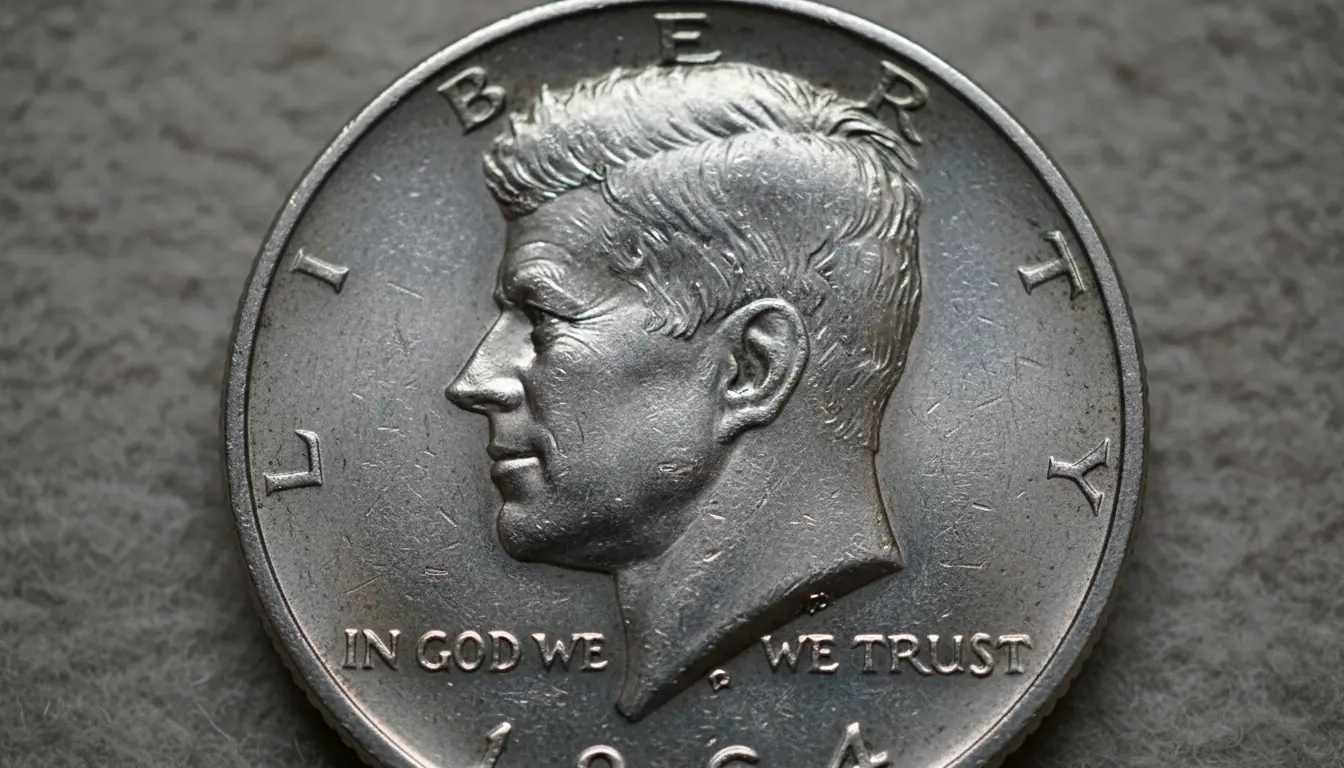
The Kennedy half dollar changed more than coin designs when it debuted in 1964. Changes in silver content, mint policy, and collector behavior around this series reshaped American numismatics and market dynamics.
How the Different Silver Kennedy Half Dollar Rewrote Coin Collecting History in USA
The Kennedy half dollar was introduced quickly after President John F. Kennedy’s assassination and immediately carried symbolic and monetary weight. Different silver compositions across years created clear collecting categories and caused large-scale hoarding and market shifts.
Timeline of Silver Content and Policy

Understanding the timeline is essential for identifying which Kennedy halves are silver and why they matter to collectors. Key changes in composition and mint policy drove collecting interest and secondary market behavior.
- 1964: First year of issue, struck at 90% silver. These coins were issued for circulation and as proofs.
- 1965–1970: Half dollars contained 40% silver. The U.S. Mint changed the alloy during this period to conserve silver and meet demand.
- 1971 onward: Half dollars became copper-nickel clad and lost silver content entirely.
Mint Mark Policy and Collector Reaction
From 1965 through 1967, the U.S. Mint temporarily removed mint marks to discourage hoarding. This decision influenced collecting patterns and trade among hobbyists. Mint marks were restored in 1968, which further created collecting distinctions.
Why These Silver Kennedy Half Dollar Varieties Matter for Collectors
The differences in silver content and mint policy produced clear collecting segments. Each segment has distinct significance for historians and investors.
- Historical value: The 1964 issue links to a pivotal national moment and is the only Kennedy half struck in 90% silver for circulation.
- Market dynamics: The 40% silver halves (1965–1970) and removal of mint marks led to hoarding and a secondary market that emphasized rarity and condition.
- Transition effect: The complete removal of silver in 1971 made earlier issues more desirable as bullion and historic artifacts.
Practical Effects on Coin Collecting

The transition produced several practical outcomes for collectors and dealers. Collecting strategies had to adapt to new realities of precious metal value and Mint policy changes.
- Hoarding and shortages: Many silver halves were removed from circulation and saved or melted, reducing available supply for collectors.
- Value separation: Silver content set a floor for intrinsic value, while rarity and condition created premiums.
- New collecting approaches: Collectors began to track varieties by year, mint mark, and silver content, rather than solely by design or proof status.
Identifying Silver Kennedy Half Dollar Varieties
Identifying whether a Kennedy half is silver is simple with a few checks. These steps help beginners and intermediate collectors quickly sort coins.
- Check the date: 1964 is 90% silver. Dates 1965–1970 are 40% silver. After 1970, halves are not silver.
- Weigh the coin: Silver halves are slightly heavier than clad equivalents. A scale that measures to 0.1 gram is useful.
- Look for mint marks and finish: Remember the mint mark removal 1965–1967; proofs and special mint sets have different finishes you can compare to references.
Quick Tests and Tools
Useful tools include a digital scale, a loupe for surface inspection, and a trusted reference or price guide. Sound tests (ringing) can help but are not definitive.
- Digital scale: Confirms weight differences.
- Magnifier: Reveals strike quality and proof features.
- Reference guides: Confirm mint policy and normal varieties for a given year.

The Kennedy half dollar was approved and produced in record time after 1963. Its 1964 silver composition and immediate public demand spurred coin hoarding that influenced Mint policies for the rest of the 1960s.
Care, Storage, and Selling Tips
Proper storage and informed selling decisions preserve value. Silver coins are sensitive to handling and environment, and market timing affects returns.
- Storage: Use inert holders or flips that are labeled archival-safe. Keep coins in a stable, low-humidity environment.
- Handling: Hold coins by the edge or wear cotton gloves to avoid oils and fingerprints.
- Selling: Know current silver prices and market demand before selling. Consider grading high-grade pieces for higher returns.
When to Grade a Kennedy Half Dollar
Grading is most useful for high-grade or rare-date pieces. Professional grading can unlock auction-level prices but adds cost and waiting time.
Case Study: A Bank Roll Discovery and Market Lesson
In the 1990s, a small-town collector found several 1964 Kennedy halves in mixed rolls from a local bank. The coins were in circulated condition but composed of 90% silver, which immediately drew dealer interest.
The collector did three things that illustrate best practice: he checked dates and weights, separated the silver pieces, and obtained a price check from multiple dealers before selling. He received offers above melt value because the 1964 date and collectible interest created premium demand beyond intrinsic silver content.
Lesson: Basic identification, patience, and shop-around practices can significantly affect selling outcomes for Kennedy half dollars.
Conclusion: Why Collectors Still Value Kennedy Silver Halves
Different silver Kennedy half dollar issues rewrote collecting history by linking design to a volatile era of metal values and Mint policy changes. The result was a modern collecting practice that combines historical interest with precious metal value.
For new collectors, learning to identify 1964 and 1965–1970 silver varieties is a practical first step. For seasoned collectors, the series offers depth in variety, condition rarity, and historical importance that continues to attract attention.