
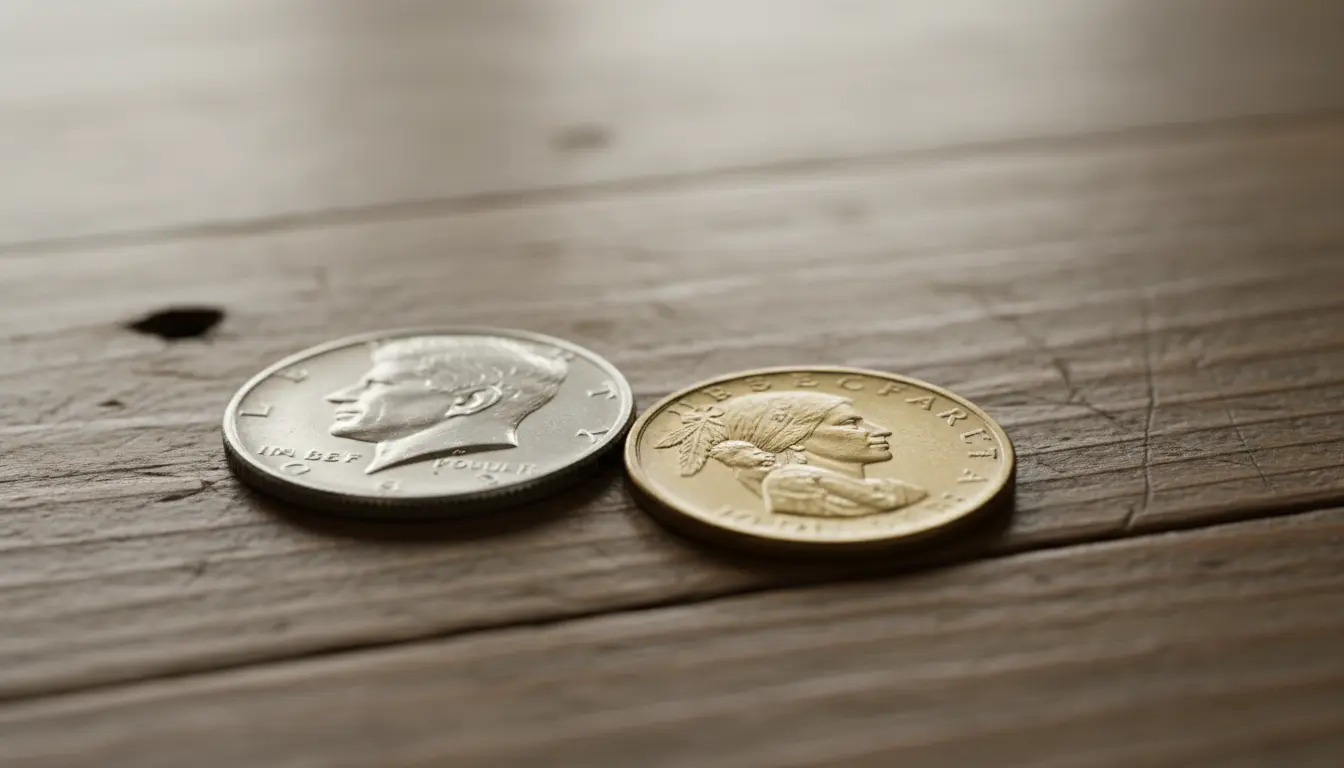
Choosing between the Sacagawea Dollar and the Kennedy Half Dollar is a common decision for beginner and intermediate collectors. Each coin has a different history, metal content, and market niche. This guide helps you compare both coins so you can decide which one fits your collecting goals.
Sacagawea Dollar vs Kennedy Half Dollar: Quick Overview
The Sacagawea Dollar debuted in 2000 as a modern U.S. dollar coin featuring Sacagawea and her child. It is popular for its golden color and modern design.

The Kennedy Half Dollar was introduced in 1964 to honor President John F. Kennedy. Early issues contain silver, and later ones are copper-nickel clad. Many collectors focus on specific years and mint marks.
Sacagawea Dollar: What to Know
Design: Obverse shows Sacagawea carrying her infant son; reverse designs have varied since 2000. The coin has a manganese-brass cladding that gives it a distinct color.
Collecting niche: Most Sacagawea dollars are modern issues intended for circulation and collectors. Interest is higher for uncirculated, proof, or limited special issues like the 2000-W gold-colored proof in sets.
Kennedy Half Dollar: What to Know

Design: The obverse features President Kennedy, with a consistent reverse eagle design on many issues. Some special redesigns and anniversary issues exist.
Metal content: 1964 Kennedy halves are 90% silver, and 1965–1970 are 40% silver. Post-1971 coins are copper-nickel clad and mostly valued for collectibility rather than metal.
Sacagawea Dollar vs Kennedy Half Dollar: Value Factors
Both coins’ values depend on condition, rarity, mint mark, and collector demand. Here are typical factors to check when assessing value:
- Mintage year and mint mark: Low-mintage years or certain mints can raise value.
- Condition and grade: Uncirculated or high-graded pieces are worth more.
- Special varieties and errors: Double dies, repunched mint marks, and planchet errors attract premiums.
- Metal content: Kennedy halves from 1964 and 1965–1970 contain silver, affecting intrinsic worth.
Pros and Cons Compared
- Sacagawea Dollar
- Pros: Lightweight, easy to store, modern and consistent design; appealing golden color.
- Cons: Many are common in circulation or mint sets; fewer high-value key dates.
- Kennedy Half Dollar
- Pros: Silver content in older issues, strong historical interest, many collectible varieties.
- Cons: Larger size takes more storage space; post-1971 coins often have low intrinsic value.
How to Choose: Collector Goals and Budget

Decide what matters most: historical interest, metal value, or design. If you want visible silver and a direct link to mid-20th-century history, Kennedy halves from the 1960s are attractive.
If you prefer a modern, colorful series with many date-and-mint combinations to collect affordably, the Sacagawea dollar series may be a better fit.
Buying and Care Tips
- Inspect coins under magnification for wear and errors.
- Buy graded coins when buying high-value or older pieces for assurance.
- Store coins in acid-free holders, flips, or capsules and avoid PVC materials.
- Consider slabbed coins for rare or high-grade specimens to preserve condition and resale value.
The 1964 Kennedy Half Dollar is 90% silver and was released just months after President Kennedy’s assassination, which spurred strong public demand and widespread collecting.
Sacagawea Dollar vs Kennedy Half Dollar: Where to Buy
Common sources include local coin shops, coin shows, online marketplaces, and reputable auction houses. For rare dates or high-grade coins, use established dealers and check third-party grading verification.
- Local coin shops: Hands-on inspection and immediate purchase.
- Coin shows: Wide selection and potential to compare prices.
- Online dealers and auctions: Good for finding specific dates but verify seller reputation.
Small Case Study: Choosing Between the Two
Case: A new collector, Sam, wanted to start a thematic collection with a modest budget. Sam visited a coin show with $200 and liked both coins’ looks.
Approach: Sam bought a slabbed 1968 Kennedy half in very fine condition because of the historic appeal and silver content in nearby dates. He also purchased a few Sacagawea dollars for design variety and affordability.
Outcome: Sam now has a mixed collection that balances historical silver pieces with modern design coins. He plans to focus on completing date-and-mint sets for Sacagawea while saving for a certified 1964 Kennedy half in the future.
Final Decision Tips
Match your choice to the type of collecting you enjoy. If you like history and precious metal, prioritize Kennedy halves from the 1960s. If you prefer modern series with many date-and-mint combinations, the Sacagawea dollar is a practical, attractive pick.
Start small, learn grading basics, and track prices for the specific dates you want. Over time, your collecting goals will clarify which coin truly sparks your collection.