
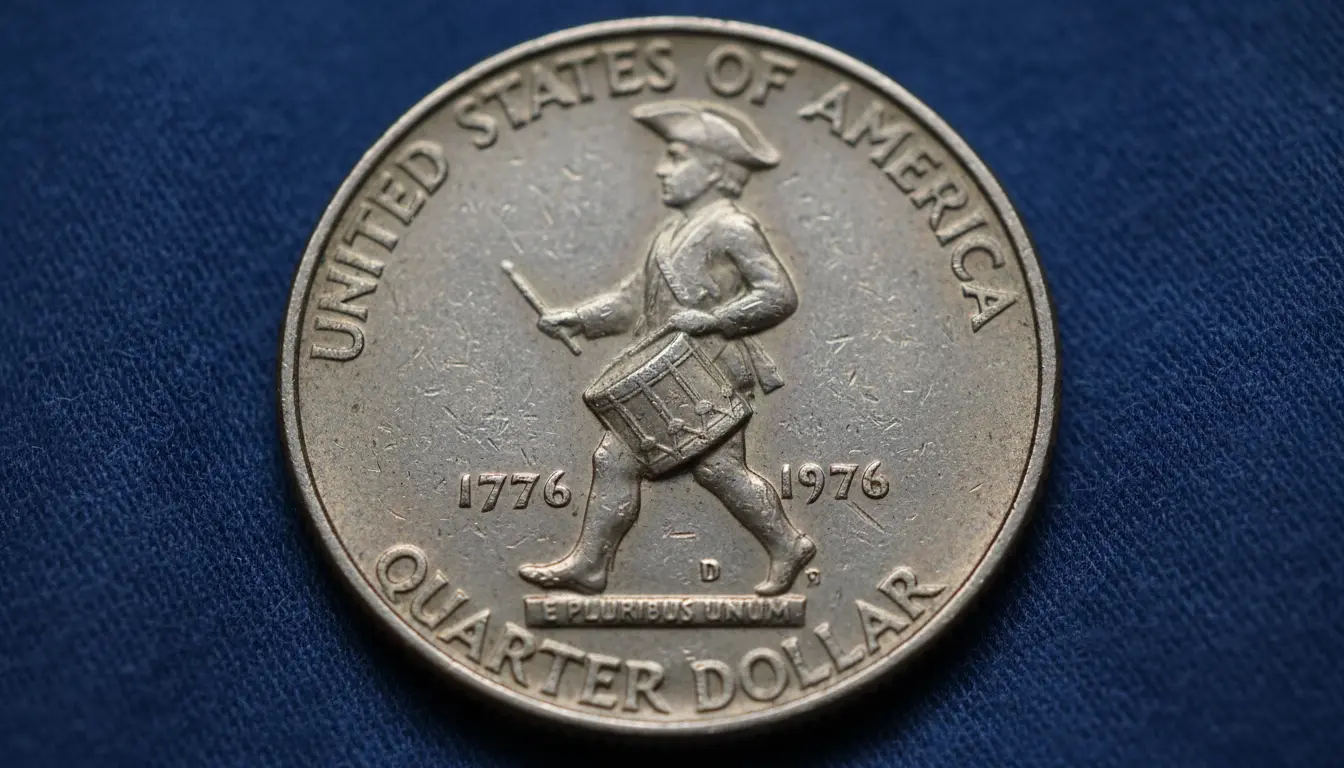
Many people toss pocket change into jars without a second thought. Among those quarters are 1976 Bicentennial designs that, while common in circulation, sometimes hide collectible varieties and errors.
Why collectors hunt 1976 Bicentennial quarters
The 1976 Bicentennial quarter was issued to celebrate the United States’ 200th anniversary and carries the dual date 1776–1976. Millions were struck for circulation, but special collector strikes, mint varieties, and minting errors can add value well above face.

Hunting these coins is practical: they are still common in circulation and easy to inspect with simple tools. Knowing what to look for helps separate ordinary quarters from potential finds.
Which 1976 Bicentennial quarters to look for
Start by scanning any 1976-dated quarter and look for key identifiers. The reverse shows the colonial drummer; the obverse uses John Flanagan’s portrait.
Pay special attention to:
- Mint mark: D for Denver, S for San Francisco proofs, and none for Philadelphia circulation pieces.
- Proof and special silver strikes: collector sets included special silver-clad pieces that differ from regular circulation coins.
- Visible mint errors: off-center strikes, clipped planchets, doubled dies, and broadstrikes.
Common error types to watch
- Doubled die — duplicated lettering or design elements.
- Off-center strikes — part of the design missing from the edge inward.
- Clipped planchets — missing crescent-shaped portions of the coin due to blanking errors.
- Die cracks and cuds — raised lines or lumps from damaged dies.
- Wrong planchet or composition — rare instances of silver-clad or other composition showing in circulation.
How to inspect your loose change for 1976 Bicentennial quarters

Use a few basic tools and follow a simple routine. A quick, consistent check increases your chances of spotting valuable coins.
Tools you’ll need
- 10x magnifying loupe or jeweler’s loupe.
- Small digital scale (optional) to compare expected weight.
- Black tray or cloth to view edges and fields.
- Reference guides or websites such as PCGS, NGC, and major auction sites for price checks.
Step-by-step inspection method
- Sort all quarters and pick out those dated 1976 with the 1776–1976 inscription.
- Check the mint mark near the ribbon on the reverse. Note S, D, or no mark.
- Use the loupe to inspect letters, date area, and fields for doubling, die cracks, or unusual marks.
- Look at the rim and edge for clipping or mismatched planchet lines.
- If something looks unusual, photograph both sides and compare with online error galleries before submitting for grading.
When a 1976 Bicentennial quarter becomes valuable
Most Bicentennial quarters in circulation are worth face value or slightly more if in very fine condition. Value increases if the coin is a certified high grade, a proof or silver-clad collector strike, or an error piece that appeals to collectors.
Typical scenarios that add value:
- High-grade uncirculated pieces (MS65 and above) that are well-preserved.
- Certified proofs and special silver strikes from mint sets.
- Clear, dramatic mint errors like large off-center strikes or major doubled dies.
Practical value ranges

These ranges are general. Always check current auction results and price guides for exact valuations.
- Circulated 1976 quarters: typically face value up to a few dollars.
- Uncirculated collector pieces: often sell for modest premiums — a few dollars to a few dozen dollars.
- Certified proofs, silver strikes, and major error coins: prices can range from tens to hundreds or more depending on rarity and grade.
The Bicentennial coins carry the dual date 1776–1976 and many were actually struck in 1975 to meet demand. Special 40% silver-clad collector versions were also produced for mint sets.
Case study: A simple pocket-check that paid off
Jane, a weekend collector, decided to scan the loose change in a jar. She picked out a handful of 1976 quarters and used a loupe to inspect them.
One coin showed an obvious clipped planchet and a pronounced die crack. Jane photographed the coin, compared it to error images on trusted numismatic sites, and sent it for grading. After certification, the coin sold on an auction platform for a higher price than a typical circulated quarter.
This example shows the value of routine inspection, basic tools, and using reputable online references before seeking grading.
Next steps if you find a candidate
If you believe you discovered a valuable 1976 Bicentennial quarter, follow these steps to maximize value and avoid mistakes.
- Do not clean or polish the coin — cleaning damages collector value.
- Document the coin with photos of both sides and the edge.
- Compare with reputable sources and similar auction listings.
- Consider professional grading from NGC or PCGS for high-grade or error coins.
- Use trusted auction platforms or coin dealers when selling.
Final practical tips for coin hunting
Make coin-checking a routine. Spend a few minutes sorting change each week or when you empty your pockets. Keep a small loupe and reference bookmarks on your phone.
Most finds will be modest, but the occasional error or high-grade piece can pleasantly reward patience and attention to detail. With careful inspection and trusted resources, your loose change could hold more than you expect.