
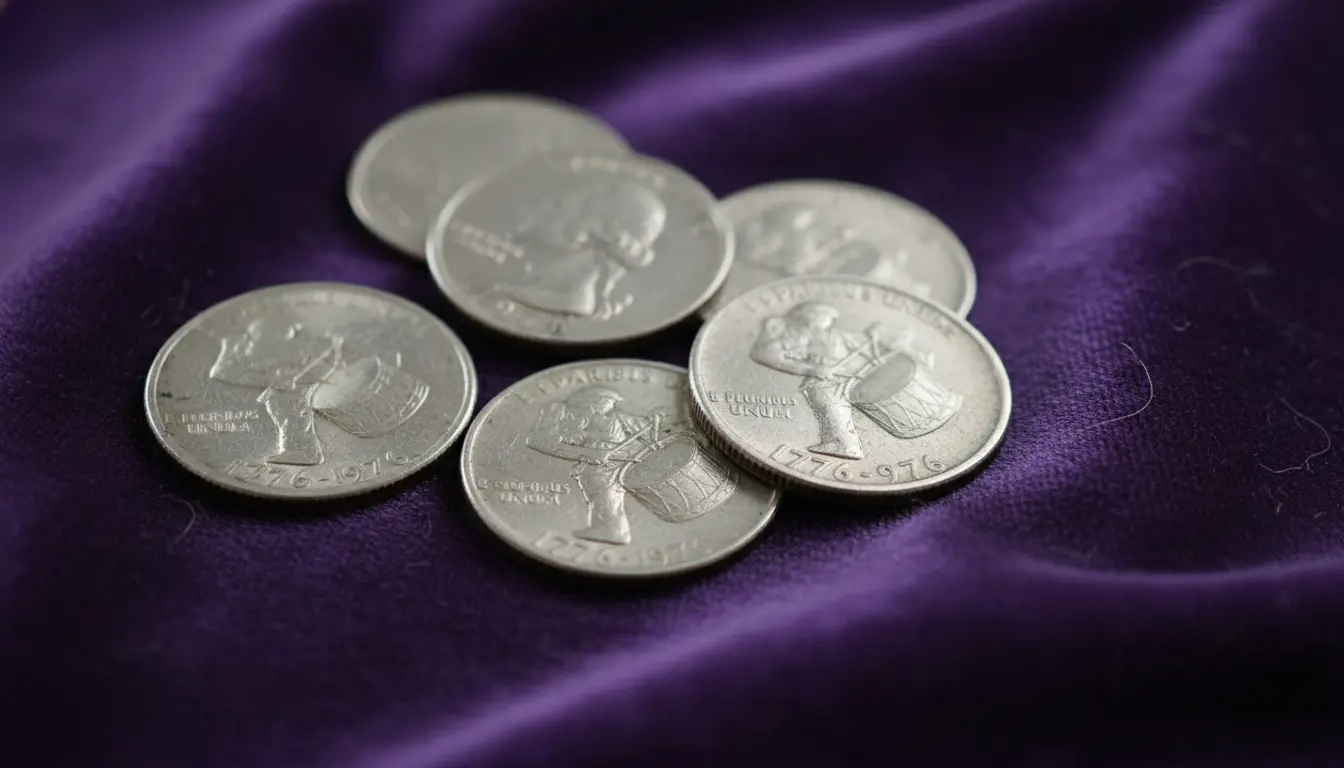
The 1976 Bicentennial quarter was produced in huge numbers for general circulation, but a few types and error pieces have become collectible. This guide explains which 1976 Bicentennial quarters still circulating are worth watching, how to identify them, and practical steps to confirm value.
Most Collectible and Valuable 1976 Bicentennial Quarters Still Circulating: Key Types
Not every Bicentennial quarter is valuable. Most are worth face value unless they fall into a special category. Collectors focus on silver issues, high-grade pieces, and obvious minting errors.

Here are the main categories that make 1976 Bicentennial quarters collectible:
- 40% silver collector coins produced for special sets
- Proof and high-grade uncirculated examples with deep luster
- Pronounced mint errors like off-center strikes, clipped planchets, or double dies
- Coins with unusual die cracks, repunched mint marks, or rare toning
Silver 1976 Bicentennial quarters
The U.S. Mint issued special collector versions of the Bicentennial coins with a 40% silver content. These were generally sold in mint or proof sets, not released for broad circulation.
Because silver quarters are distinct from the regular copper-nickel clad pieces, they often command higher prices with collectors. If you find a quarter with a uniform silver-colored edge (no copper stripe), it may be a silver piece.
Error and Variety Quarters

Errors and varieties are common reasons otherwise ordinary coins become valuable. For the 1976 quarter the most frequently sought error types include off-center strikes, broadstrikes, clipped planchets, and strong doubling.
Even modest errors can be appealing to collectors if they are dramatic and well-preserved. The rarer and more visually obvious the error, the higher the market interest.
How to Identify Valuable 1976 Bicentennial Quarters Still Circulating
Use simple checks before assuming a coin is valuable. Many common features are easy to spot with a magnifier and a few tools.
- Edge inspection: Silver coins show a consistent silver color around the edge; clad coins reveal a copper-colored stripe at the center edge.
- Mint mark and finish: Proof coins from San Francisco often have an S mint mark and sharper details than circulation strikes.
- Error signs: Look for misalignment, missing elements, doubling, and unusual struck surfaces.
- Condition matters: Coins without wear, with original luster or attractive toning, are much more valuable.
Tools that help

A 10x loupe, a simple scale, and a reference guide or price checklist are sufficient for most initial inspections. If the coin appears to be silver or shows a dramatic error, consider professional grading.
Practical Steps to Confirm Value and Sell
Follow a straightforward process to verify and realize the value of any suspect quarter you find.
- Document the coin with clear photos of obverse, reverse, and edge.
- Compare to reference photos online and in coin guides for the 1976 Bicentennial quarter.
- Check auctions and completed sales for similar coins to estimate demand.
- If the coin looks rare or in very high grade, consider third-party grading (PCGS, NGC) to unlock top market prices.
Local coin shops can provide quick feedback but may offer wholesale prices. For the best return, sell through reputable auction houses or graded-coin marketplaces.
When to get a coin graded
Grading is worthwhile when a coin appears to be silver, is an obvious error, or looks like a high mint state (MS) or proof (PR) example. Grading costs money, so limit it to pieces with enough potential value to justify the expense.
Some Bicentennial coins were issued only in special sets with 40% silver; these collector pieces are easiest to distinguish by an even silver-colored edge and stronger strike than circulation coins.
Real-World Example: Finding Value in a Box of Change
A hobbyist sorting through a box of coins discovered a Bicentennial quarter with a very even silver tone and unusually sharp details. It turned out to be a San Francisco proof strike originally placed in a mint set.
After photographing the coin and checking auction listings, the collector submitted it for grading. The graded proof received good online interest, and the sale netted a multiple of face value—enough to justify the grading fee.
This case highlights the value of checking edges and finishes and comparing to known collector varieties before selling directly to a dealer.
Common Questions
Are most 1976 quarters valuable? No—most are worth face value unless they are silver, error, or high-grade pieces.
Can you find valuable ones in circulation? Rarely, but mistakes and mis-sorted collector coins occasionally enter circulation. Careful inspection pays off.
Is grading always necessary? Not always. Use grading for high-potential pieces. For most small errors or moderately worn silver coins, selling to collectors or dealers without grading can be efficient.
Final Tips for Collectors
- Check edges first to separate potential silver-clad pieces from regular clad coins.
- Keep coins in protective holders to preserve condition if you think they have value.
- Research recent sales and stay conservative in price expectations until a coin is authenticated.
- Use reputable graders and auction platforms for the best results on high-value pieces.
With some patience and careful inspection, collectors and hobbyists can find the most collectible and valuable 1976 Bicentennial quarters still circulating. Focus on silver issues, bold errors, and high-grade examples to maximize the chance of finding a worthwhile coin.