
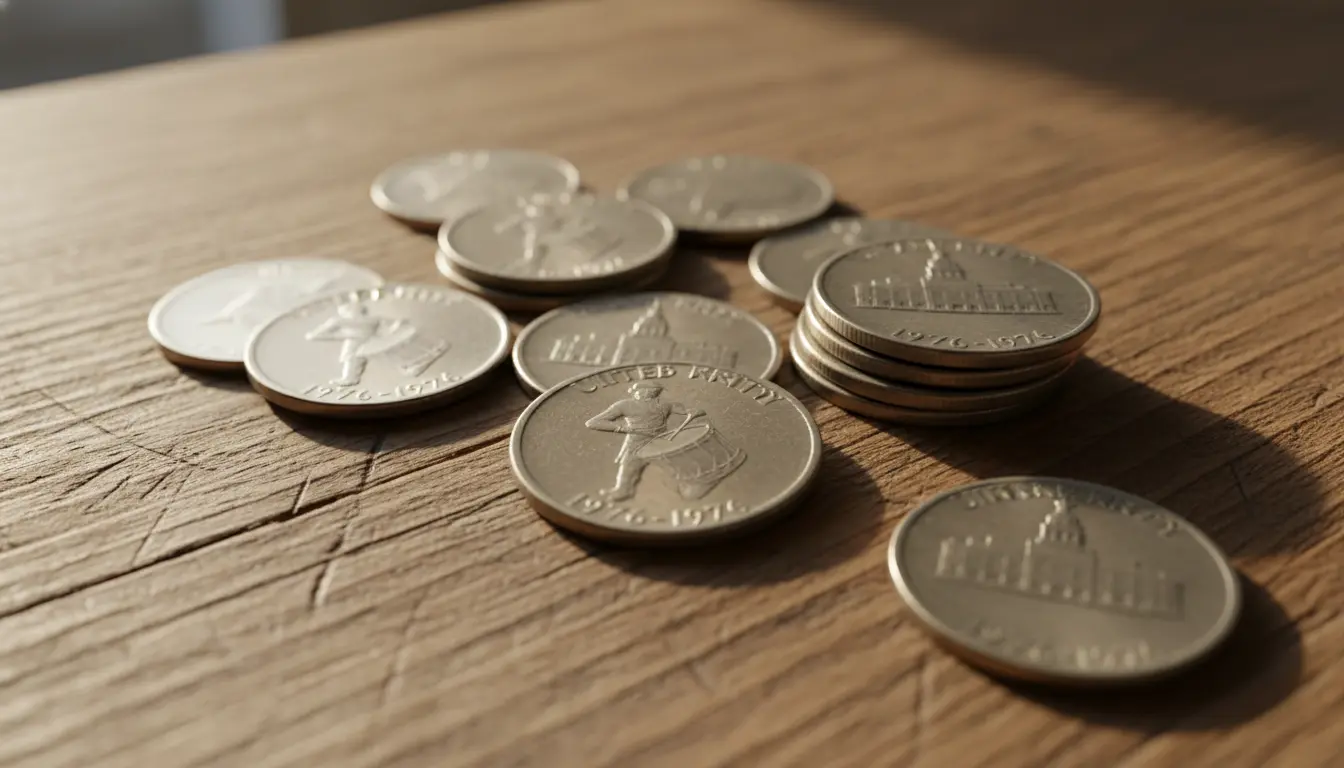
The 1976 Bicentennial quarter is familiar to many collectors and casual holders because of its special dual date 1776-1976 and drummer-boy reverse. Most circulated examples remain close to face value, but certain varieties and conditions are collectible and can carry real premiums.
Why 1976 Bicentennial Quarters Matter
The U.S. Mint issued the Bicentennial design to celebrate the nation’s 200th anniversary. The unique reverse, by Jack L. Ahr, replaced the eagle design for the year and appears on quarters, half dollars, and dollars dated 1776-1976.

Because millions were struck for circulation and for collector sets, most 1976 quarters are common. However, special mint products, high grades, and striking errors create the coins that remain collectible and valuable.
Design and production notes for 1976 Bicentennial Quarters
The quarter bears the dual date 1776-1976 and the drummer-boy reverse. Regular circulation strikes are copper-nickel clad, while special proof and some mint set coins were issued in 40% silver from San Francisco.
These production differences are key when identifying quarters that may be worth more than face value.
Most Collectible 1976 Bicentennial Quarters Still Circulating

Collectible 1976 Bicentennial quarters generally fall into three categories: silver-clad collector issues, high-grade circulation strikes, and error/variety coins. Knowing what to look for helps you spot value in change.
- 40% Silver Proof and Uncirculated Quarters (1976-S) — These were sold in proof and mint sets from San Francisco and are easily identified by the S mint mark and silver content. They usually show sharper details and a different look than common clad coins.
- High-Grade Mint State Clad Quarters — A regular clad quarter in MS65 or higher can be worth a premium to specialists. Look for strong luster, full strike, and no contact marks.
- Error and Variety Coins — Off-center strikes, clipped planchets, broadstrikes, die cracks, doubled dies, and repunched mint marks can be valuable depending on severity and documentation.
How to identify 40% silver 1976 Bicentennial quarters
Silver quarters were included in 1976-S proof and uncirculated sets. Check the obverse for a small S mint mark and inspect the edge for a consistent silver tone. These coins are magnetic negative and will have a slightly different ring when tapped.
Because silver content significantly increases collector interest, these are often the first targets for buyers and dealers when searching for valuable 1976 quarters.
Common Error Types to Watch For

Error coins often reach collectors through bulk lots, circulation finds, or estate collections. Not every error is rare, but dramatic or well-documented examples are desirable.
- Off-center strikes: Values depend on percentage off-center and overall appearance.
- Clipped planchets: Look for missing metal at the rim in a curved crescent shape.
- Doubled die or DDO: Doubling on letters or date can indicate a doubled die obverse or reverse.
- Broadstrikes and struck-throughs: These alter the coin’s normal rim and fields and can be collectible.
What increases value for error 1976 quarters
Severity, visibility, and provenance matter. A small strike-through might be interesting, but a dramatically off-center strike authenticated by a reputable grader will command a higher price.
Practical Tips for Finding and Evaluating Valuable 1976 Quarters
Most valuable examples are either in original sealed sets or have clear error/variety features. Here are focused steps to evaluate coins you find in circulation.
- Check mint marks: S indicates proof silver examples; D and no mint mark are common circulation issues.
- Inspect under good light: Look for doubling, die cracks, and planchet issues.
- Use a scale or acid test only for silver when necessary; better to consult a professional to avoid damage.
- Consider third-party grading for high-value pieces (PCGS, NGC). Grading provides market confidence and can increase sale price.
Storage and handling advice
Handle coins by the edges and store in inert holders or archival flips. Avoid cleaning coins, which usually destroys collector value. Keep proofs in original packaging when possible.
The Bicentennial quarter’s drummer-boy reverse appears on all denominations of the special 1976 circulating coinage, making the year uniquely identifiable to collectors and casual users alike.
Small Case Study: Finding Value in a Saved Set
A collector bought a 1976-S proof set in 1976 and kept it sealed. Decades later the silver quarter was still in original packaging and in near-perfect condition. When examined by a dealer and graded, it was more valuable than a typical circulated quarter because of its silver content and condition.
This example shows that proper storage and finding the right market are often the best ways to realize value from Bicentennial quarters.
When to Sell or Seek Grading
Consider grading if a coin is a high-grade specimen, an obvious major error, or a silver proof in excellent condition. For modest finds or common circulation pieces, selling to a reputable dealer or on a collector marketplace is usually sufficient.
Obtain multiple opinions for unusual pieces and document any provenance or purchase records to improve sale potential.
Final Checklist for Collectors of 1976 Bicentennial Quarters
- Identify mint mark and check for S (silver proofs).
- Look for obvious errors: off-center, clipped planchets, doubling.
- Assess overall grade: luster, strike, and marks matter.
- Preserve coins in original packaging where possible.
- Get professional grading for high-value or rare items.
With patience and careful inspection you can still find collectible and valuable 1976 Bicentennial quarters in circulation and collections. Focus on silver proofs, significant errors, and high-grade examples to maximize chances of meaningful value.