
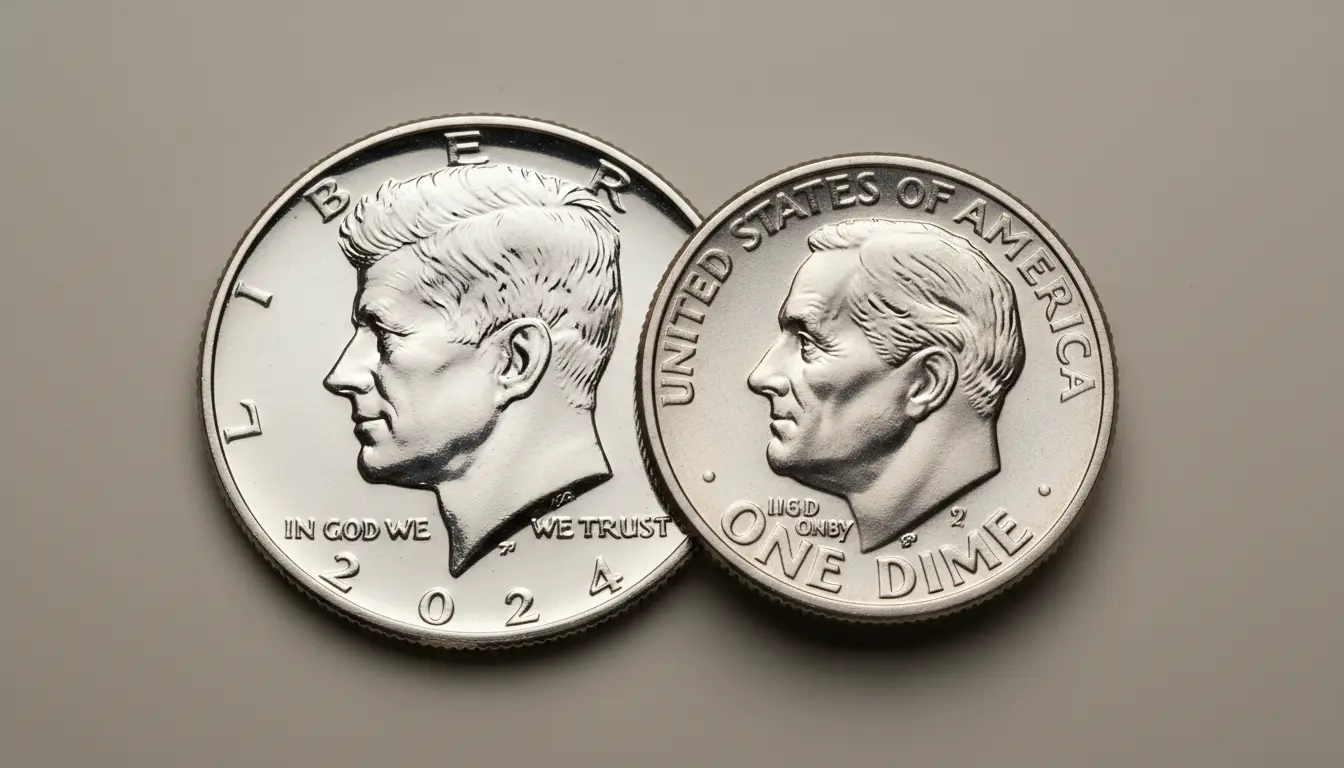
The Kennedy Half Dollar vs Roosevelt Dime comparison helps collectors and casual buyers decide which coin to focus on. This guide explains physical differences, metal content, typical values, and practical buying tips.
Understanding the Kennedy Half Dollar vs Roosevelt Dime
Both coins are modern U.S. circulation pieces but serve different roles for collectors. The Kennedy Half Dollar was introduced in 1964, while the Roosevelt Dime dates to 1946.

Knowing the basics—size, composition, and common dates—lets you spot valuable pieces quickly. This section summarizes those fundamentals.
Physical and Metal Differences
The Kennedy Half Dollar is larger and heavier than the Roosevelt Dime. Size and weight are useful for instant identification without close inspection.
Key differences include metal content and appearance. Early issues contain silver while later examples are primarily copper-nickel.
- Kennedy Half Dollar: Diameter about 30.6 mm; 1964 is 90% silver, 1965–1970 are 40% silver, 1971 onward are copper-nickel clad.
- Roosevelt Dime: Diameter about 17.9 mm; 1946–1964 are 90% silver, 1965 onward are copper-nickel clad.
How Condition and Date Affect Value

Date and condition are the two strongest value drivers for both coins. A common modern coin in worn condition is usually only face value or slightly above.
High-grade examples, proofs, and rare dates bring premiums. For example, a 1964 Kennedy Half Dollar in uncirculated condition can be worth significantly more due to the 90% silver content.
Key Dates and Varieties
Watch for specific years and mint marks. Some Roosevelt dimes and Kennedy halves have error varieties or low mintage issues that are collectible.
- Kennedy Half Dollar highlights: 1964 (90% silver), 1965–1970 (40% silver), certain proof sets and special mint errors.
- Roosevelt Dime highlights: 1946–1964 (90% silver), 1968-S (proofs), Mercury-era proof or error dimes are collectible but less common for this series.
Practical Tips for Buyers: Kennedy Half Dollar vs Roosevelt Dime

Decide whether you collect for metal value, historical interest, or grade. Each approach changes which coin is better for you.
Follow these practical steps when buying coins.
- Always check the date and mint mark under good light or with a magnifier.
- Weigh the coin if metal composition is in question; silver coins will weigh slightly more than clad counterparts.
- Use an up-to-date price guide or marketplace to check recent sale prices for the exact date and grade.
Storage and Grading Tips
Proper storage preserves value. Use coin flips, capsules, or archival holders and keep coins away from humidity and direct sunlight.
Professional grading can boost value for rare dates or high-grade coins but has fees. Decide case-by-case for each coin.
Market Value Comparison
Market value depends on silver content, condition, and rarity. In general, silver Kennedy halves from 1964 and Roosevelt dimes from 1946–1964 have intrinsic silver value based on current bullion prices.
Non-silver clad issues usually trade close to face value unless in exceptional condition or rare variety. Collectors often pay more for attractive toning, full bands, or mint errors.
Examples of Typical Values
- 1964 Kennedy Half Dollar (90% silver): melt value plus collector premium; often several times face value.
- 1955 Roosevelt Dime (90% silver): value tied to silver weight and condition; many are worth several dollars to collectors.
- Post-1965 clad versions: typically face value unless uncirculated or proof.
The Kennedy Half Dollar was issued soon after President John F. Kennedy’s death in 1963. The Roosevelt Dime was created to honor President Franklin D. Roosevelt and first appeared in 1946.
Short Case Study: Estate Sale Find
A collector visited a local estate sale and purchased a small coin lot including a 1964 Kennedy Half Dollar and a 1952 Roosevelt Dime. The buyer paid $10 for the lot without checking dates closely.
After inspection, the 1964 half fetched more than $10 on the spot because of its 90% silver content. The 1952 dime added more silver value, making the $10 purchase a clear profit after simple research.
Which Should You Choose: Kennedy Half Dollar vs Roosevelt Dime?
Choose by goal. If you want larger silver content and a standout piece, the Kennedy Half Dollar from 1964 is attractive. If you prefer a long-running series with many collectible dates, Roosevelt dimes offer breadth.
For beginners, focus on identifying silver dates first. That gives clear intrinsic value and helps build a foundation in coin recognition and grading.
Quick Decision Guide
- Collect silver bullion and larger coins: prioritize 1964 Kennedy Half Dollar.
- Build a national series with many date challenges: focus on Roosevelt Dime dates and mint marks.
- Budget collecting: look for high-grade post-1965 examples or affordable proof sets.
Comparing the Kennedy Half Dollar vs Roosevelt Dime is about matching your collecting goals with the coin’s attributes. With basic tools and a little research, you can confidently evaluate, buy, and store either series.
Use this guide as a starting point. Check current price guides and auction results for the latest market trends before making significant purchases.