
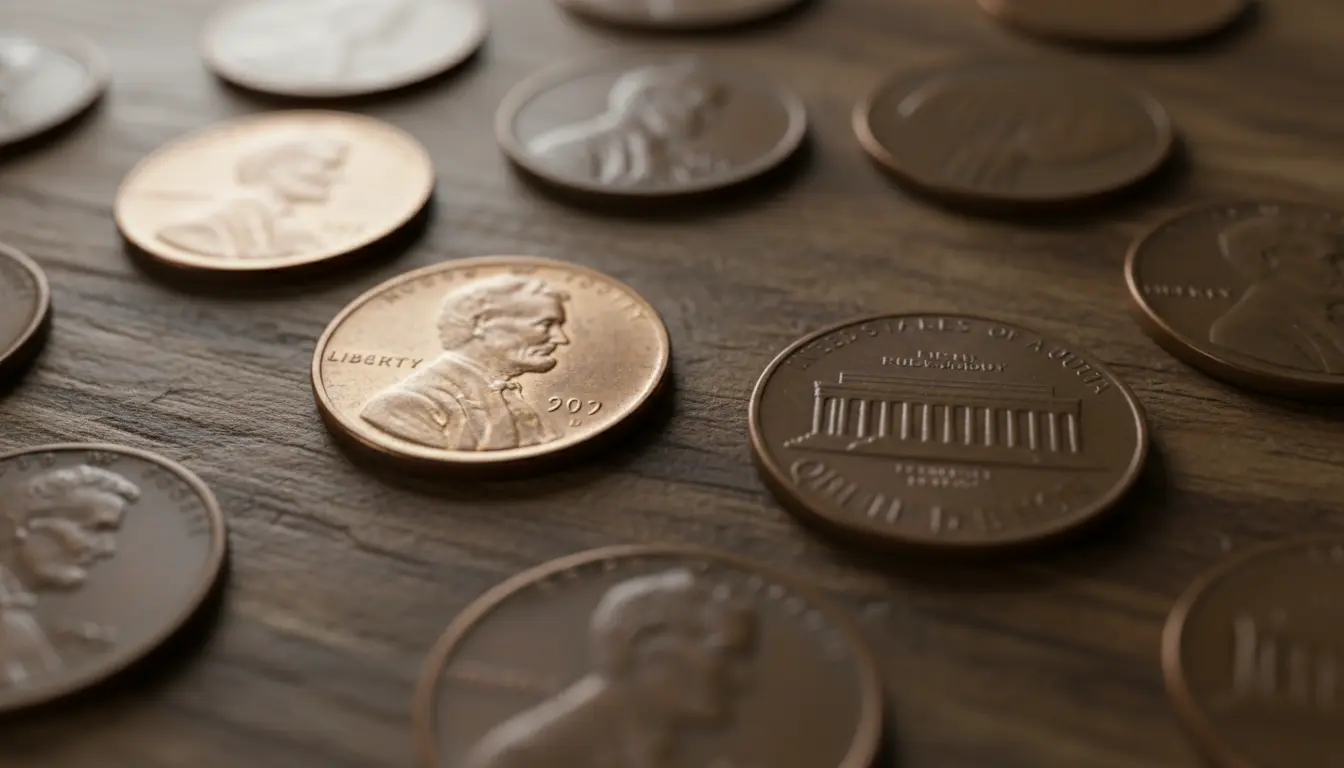
Many collectors and casual savers pass through thousands of Lincoln pennies without realizing some can be worth far more than face value. This guide lists 10 rare Lincoln pennies that occasionally still appear in circulation and explains how to spot them.
How to check for rare Lincoln pennies
Start by sorting coins by date and mint mark. Use good light and a magnifier to look for unusual details like doubled letters, missing mint marks, or wrong metal color.

If you think a coin might be rare, isolate it and compare it to clear reference photos from PCGS, NGC, or the U.S. Mint. Condition dramatically affects value, so avoid cleaning the coin.
Top 10 rare Lincoln pennies still in circulation
1. 1909-S VDB Lincoln Cent
Why it’s rare: Low mintage and the initials VDB (designer Victor David Brenner) on the reverse were removed mid-run, making original VDB pieces scarce.
How to spot it: Look for VDB on the reverse near the rim and an S mint mark under the date. Value can range from several hundred to several thousand dollars depending on condition.
2. 1909-S (no VDB)

Why it’s rare: The San Francisco 1909 no-VDB variant has a small mintage relative to demand.
How to spot it: Absence of VDB on the reverse, S under the date. High-grade examples are collectible and can fetch strong prices.
3. 1914-D Lincoln Cent
Why it’s rare: A low Denver mintage makes the 1914-D a key date for collectors.

How to spot it: Look for the small D mint mark. Even worn circulated examples can be valuable compared with common dates.
4. 1922 Plain (No D) Lincoln Cent
Why it’s rare: Many 1922 cents were overstruck at Denver; pieces without a visible D mint mark exist and are sought after.
How to spot it: No clear D under the date but indicators of a weakly struck coin. Genuine plain 1922s in better grades are very valuable.
5. 1931-S Lincoln Cent
Why it’s rare: Low San Francisco mintage and survival rate make the 1931-S scarce.
How to spot it: S under the date; look for strong wear but clear mint mark. Values rise quickly with better surfaces and strike.
6. 1943 Copper Lincoln Cent
Why it’s rare: Most 1943 cents were made of steel due to wartime copper needs; a few copper planchets were mistakenly used.
How to spot it: Copper color and weight; a magnet will not stick. Genuine pieces are extremely rare and can be worth tens or hundreds of thousands of dollars depending on authenticity and grade.
7. 1955 Doubled Die Obverse
Why it’s rare: A major die error caused strong doubling on the obverse lettering and date.
How to spot it: Prominent doubling on IN GOD WE TRUST, LIBERTY, or the date. Even worn pieces are collectible and can command hundreds to thousands of dollars.
8. 1969-S Doubled Die Obverse
Why it’s rare: Limited die errors at San Francisco produced a few notable doubled dies.
How to spot it: Look for doubling on the date and LIBERTY. Authenticate suspected examples with images from grading services.
9. 1972 Doubled Die Obverse
Why it’s rare: Another famous doubled die that appears on some circulation-struck cents from Philadelphia.
How to spot it: Strong doubling on the obverse inscriptions and date. Condition impacts value; uncirculated pieces bring premium prices.
10. 1992 Close AM Lincoln Cent (Proof and Business Varieties)
Why it’s notable: Some 1992 cents show a Close AM (the A and M in AMERICA appear close together) and other subtle variety differences, which attract modern collectors.
How to spot it: Compare reverse lettering spacing with reliable reference images. Value is modest compared with older key dates but still noteworthy for variety collectors.
Tips for safely checking change
- Use a 10x loupe and good daylight or a bright lamp.
- Do not clean coins; cleaning lowers value.
- Compare suspected rarities with verified images from PCGS or NGC.
- If unsure, have the coin graded by a reputable service.
Some of the most valuable pennies were found in everyday change. A genuine 1943 copper penny can be worth six figures, but confirmed examples are tested for metal composition and provenance.
Real-world example: Finding a rare penny in circulation
Case study: A buyer at a flea market received a 1955 doubled die obverse in change. They noticed heavy doubling on the date and lettering and compared photos online.
Outcome: After authentication by a grading service, the coin was graded and sold to a collector. The sale price ranged in the low thousands, showing how a single discovery can pay off.
When to get a coin professionally graded
Consider grading if a coin appears to be a key date, an extreme error (like copper 1943), or a high-grade early 20th-century piece. Grading provides authentication, a condition grade, and a market benchmark.
Remember that not every odd or worn coin is rare. Use reputable references and consult experienced dealers for a second opinion.
Final note: Values change with the market, and condition matters. If you find a coin that looks unusual, handle it carefully, document it with photos, and seek expert verification before selling or cleaning.